
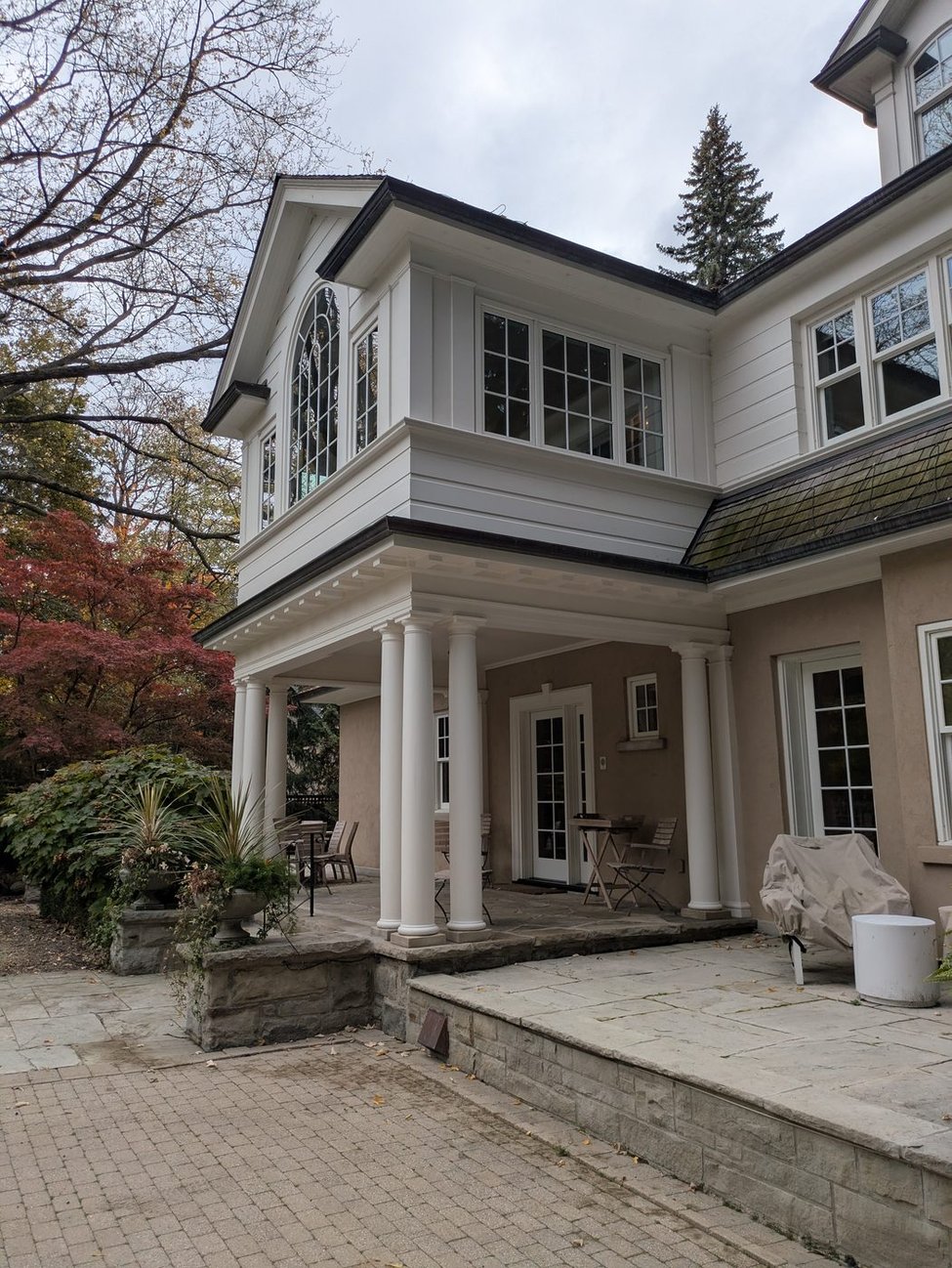
The place
Kortright Hills sits in Guelph's south end, on the east side of the Hanlon Expressway, roughly between Stone Road and Downey Road. It is one of South Guelph's established neighbourhoods, and the kind of place that has earned a quiet reputation: locals will tell you the homes here are among the largest in the city, and the streets carry that comfortable, settled feeling of a neighbourhood that was built well and looked after.
The area was built mainly in the 1980s and 1990s, with homes spreading out over several decades rather than in a single boom. The footprint will feel familiar if you know Kortright West: spacious detached homes on generous lots, nearly all with garages and three or more bedrooms. The 2021 census counted about 84% of the homes as single detached (the rest mainly townhouses and duplexes), and about 95% of households own rather than rent.
One of the best things about Kortright Hills is how much greenspace the developers left in place. It is common for a home here to back onto a park, a pond, or a forested patch, and Crane Park and the Hanlon Creek corridors are easy to reach from most streets. The major landmark is the Guelph YMCA (YMCA of Three Rivers) at 130 Woodland Glen Drive, right at Woodland Glen and Downey Road, a short drive south. The trade-off for the area's tucked-away feel is that day-to-day shopping takes a short drive: Stone Road Mall is across the Hanlon, so most households drive for groceries and errands.
Who lives here
Kortright Hills is family country. Demographic profiles consistently describe it as a small, quiet, higher-income residential neighbourhood, popular with families with teens as well as people in their 20s, 40s, and 50s. Roughly six in ten households have kids at home, about a quarter are couples without children, and only around one in ten households is a single person living alone.
The area skews established and well-off: the 2021 census put average household income here at about $181,000, with a median of about $156,000, against a median household income of about $93,000 for Guelph as a whole, and more than four in ten residents hold a degree or higher. About one in five residents was born outside Canada, with 52 different ethnic origins represented, so there is real diversity on the street alongside that settled, long-term feeling.
That is the Kortright Hills mix: executives, educators, health and public-sector professionals, and a lot of people who moved up to a bigger home here in the 80s and 90s and never saw a reason to leave.
The homes
This is one of the best bets in the south end if you want space. The housing stock is overwhelmingly single detached homes, with some duplexes and a few townhome pockets mixed in. The homes here are mainly three-bedroom and four-plus-bedroom layouts: the big family houses the neighbourhood is known for, and about 95% of households own rather than rent.
Age-wise, most homes went up between 1981 and 2000 (about seven in ten, with the biggest building wave in the 1990s), and roughly one in five was built in the early 2000s. That means classic two-storey brick-and-siding family homes with attached garages and generous yards.
If you are buying here, the inspection checklist is different from an older neighbourhood like Old University: less knob-and-tube, more original-furnace and original-windows questions. A mid-80s home still wearing its first roof and windows is a negotiation conversation, not a dealbreaker. That is one I am always happy to have with you before you write, not after.
Schools
Schools are one of the reasons families land here. The neighbourhood's own elementary school is Kortright Hills Public School, a Junior Kindergarten to Grade 8 school in the Upper Grand District School Board, at 23 Ptarmigan Drive, right in the heart of the neighbourhood.
Secondary assignment, regular track: the Upper Grand board's new secondary school boundary review (Report 8, Recommendation Report) states that students from Kortright Hills Public School will continue to attend Centennial Collegiate Vocational Institute for Grades 9 to 12. That resolves the regular-track secondary question that earlier drafts left open.
French immersion: Kortright Hills Public School itself is a regular track school only. The Upper Grand board's 2026/27 boundary maps list it as JK to 8 Regular Track, not as a French immersion centre. Guelph French immersion elementary is offered at designated immersion centres, for example École King George Public School (JK to 8 French immersion). Which centre serves your address is street-specific, so confirm it with the board's school locator before you buy. Catholic-board (Wellington Catholic DSB) elementary: St. Michael Catholic School serves Kortright Hills (alongside Rickson Ridge and Old University). Catholic secondary options are street-specific, so confirm your exact address with the Wellington Catholic school locator before you buy. The Wellington Catholic board's south end secondary school is Bishop Macdonell Catholic High School at 200 Clair Road West, in Clairfields, south of Kortright Hills, and it is the high school St. Michael students move on to.
Parks and trails
This is the part of the neighbourhood that sells itself on a weekend walk. Crane Park is the big one: trails along the Speed River in the southwest corner of the city, with cedar and deciduous forest, shoreline benches, and river views, plus an off-leash dog park for the four-legged family members. The Crane Park loop trail is about 2.7 miles of easy, mostly flat walking that takes most people just over an hour (alltrails.com), and you can reach it on foot from the neighbourhood, with trailheads at the southwestern corner of Stone Road West, the western end of Dovercliffe Road, and the southwestern corner of Conroy Crescent. Local listing descriptions in Kortright Hills specifically mention walking trails leading to Crane Park and the Speed River Trail from inside the neighbourhood.
The Hanlon Creek corridor is the other backyard. The Hanlon and Preservation Park loop is a 5.1 km mix of cedar forest, open meadow, and boardwalks, with trailheads at Hanlon Creek Park (505 Kortright Road West), Terraview Crescent off Edinburgh Road South, and Kortright Road West between Edinburgh Road South and Ironwood Road (gatheringuelph.com). It is well groomed but rooted and rocky in spots, so it feels like a proper little escape without leaving the south end.
Closer to home, Kortright Hills Park on Milson Crescent has a playground and is the easy default for an after-school burn-off. Mollison Park sits right behind Kortright Hills Public School: the school's own page notes that its yard backs onto Mollison Park, with a tennis court, a baseball diamond, and playground equipment easily accessible from the yard.
Getting around and everyday life
This is a driving neighbourhood, and most residents plan it that way. The Hanlon Expressway runs along the west side, with Kortright Road West and Stone Road West as the main ways in and out, so downtown, the University of Guelph, and Highway 401 connections are all reached by car first. That is the honest trade for the quiet streets and bigger lots.
Everyday shopping is a short drive rather than a walk. Stone Road Mall (435 Stone Road West) and the Stone Road West big box and grocery cluster sit just across the Hanlon, and most households batch errands there. Stone Road Mall's anchors are Marshalls, Sport Chek, and Chapters-Indigo. The closest full grocery stores are the Zehrs at 160 Kortright Road West, at Edinburgh Road South, and the Farm Boy at 370 Stone Road West, with a Metro at 500 Edinburgh Road South also close by.
Transit exists, but it is built around the university. Guelph Transit Route 52U Kortright is a University Express route that runs from University Centre along Gordon Street and Kortright Road to Edinburgh Road South, operating Monday to Friday from September to April only. Conventional routes also serve the edges of the south end: the current Guelph Transit route list includes Route 6 Ironwood, Route 7 Niska, Route 19 Hanlon Creek (Clair to Stone Road Mall), and Route 99 Mainline along Gordon Street. One conventional route does stop inside the neighbourhood itself: Route 7 Niska runs between University Centre and a terminus at Ptarmigan Drive at Downey Road, right by Kortright Hills Public School, following Kortright Road West, Downey Road, and Niska Road through the area on the way. Buses run about every 20 to 30 minutes on weekdays and every 30 minutes on weekends.
Market snapshot
Kortright Hills trades at a premium to the Guelph average, which fits the bigger homes and lots. Detached homes are the story here: over the 12 months to September 2026, at least 12 detached homes sold at a median price of about $1,013,000, took a median of 26 days to sell, and closed at about 97.9% of asking. Shorter windows jump around a lot: August 2026 alone saw 6 detached sales at a median of $916,250 and a median of 35 days on market. Treat all of these as directional only: this is a small neighbourhood with a small number of sales in any window, so one or two large homes can move the numbers a lot.
FAQs
Is Kortright Hills a good neighbourhood for families?
It is one of South Guelph's most family oriented areas: an elementary school right in the neighbourhood, big three and four bedroom detached homes, and parks and trails at the edges of the streets. Roughly six in ten households have kids at home, based on the census-based demographic profile cited above (hoodq.com: families with children 59% of households).
Which schools serve Kortright Hills?
Kortright Hills Public School, at 23 Ptarmigan Drive, serves Junior Kindergarten to Grade 8 in the Upper Grand District School Board. For the regular track, the board's boundary review Report 8 states that Kortright Hills Public School students continue to Centennial Collegiate Vocational Institute for Grades 9 to 12. Always confirm your exact address with the board's school locator before you buy, especially for French immersion and Catholic-board options. On the Catholic side, St. Michael Catholic School serves Kortright Hills at the elementary level, and its students move on to Bishop Macdonell Catholic High School, as noted in "Schools" above.
What do homes cost in Kortright Hills?
Over the 12 months to September 2026, detached homes (the large majority of what sells here) sold at a median of about $1,013,000 across at least 12 sales, closing at about 97.9% of asking (HomeH market data compiled from TRREB MLS sales, accessed October 25, 2026). This is a small neighbourhood, so a few large sales can move those numbers a lot. I will pull a current, MLS sourced snapshot for your street before you make any decisions.
How do you get around from Kortright Hills?
Mostly by car. The Hanlon Expressway runs along the west side of the area, with Kortright Road West and Stone Road West as the main routes out, and Stone Road Mall and the Stone Road West shopping cluster are a short drive across the Hanlon. Guelph Transit Route 52U Kortright is a University Express route running Monday to Friday from September to April only, so plan on driving for most everyday trips.
What is there to do outdoors?
Plenty. Crane Park offers trails along the Speed River and an off-leash dog park, the Hanlon Creek and Preservation Park corridors give you forest and boardwalk loops close to home, and Kortright Hills Park on Milson Crescent is the neighbourhood playground default. It is one of the greenest corners of the south end.
Thinking about Kortright Hills?
I know these streets: the big family homes backing onto greenspace, the blocks near Kortright Hills Public School on Ptarmigan Drive, and the quiet pockets down toward Downey Road and the YMCA on Woodland Glen Drive. If you are thinking about buying or selling here, I am happy to walk a street with you, pull current numbers for your home, and talk it through with no pressure.
Shelley Lorenz, Salesperson, Royal LePage Royal City Realty, 30 Edinburgh Rd N, Guelph. This guide is general information, not advice. Market figures are dated at publication and must be refreshed before publication.