
Navigating the real estate landscape in Guelph requires a clear look at official regional market metrics. Across Guelph, average monthly rents hover around $2,145, with typical two-bedroom units ranging between $2,180 and $2,280 per month. While renting offers budget flexibility and freedom from maintenance fees, purchasing a home allows you to accumulate long-term equity. Deciding which route makes sense comes down to balancing immediate monthly carrying costs against long-term equity potential and your current housing situation.
According to data compiled by the Canadian Real Estate Association (CREA), entry-level benchmark properties in Guelph such as condo townhouses and apartments average roughly $569,200 and $461,300, respectively, while the overall composite benchmark price sits near $717,300. Consider a homebuyer purchasing an entry-level condo townhouse at $569,200 with a 10% down payment ($56,920). At current 5-year fixed interest rates near 4.0%, the base mortgage payment is roughly $2,690 per month. Adding property taxes (~$354/month), condo maintenance fees ($350–$450/month), and home insurance ($75/month), the total carrying cost lands around $3,470 to $3,570 monthly. (Note: Freehold townhomes without monthly condo maintenance fees typically carry higher baseline purchase prices).
Comparing that to renting a two-bedroom apartment at $2,250 per month shows a monthly cash-flow difference of roughly $1,220 to $1,320 in favour of renting. While renting wins on raw monthly out-of-pocket expenses, it excludes wealth creation. In the early years of a mortgage, nearly $1,000 of that monthly payment goes directly toward paying down the principal balance. When accounting for forced savings via principal reduction, the net financial gap between renting and owning shrinks significantly. Additionally, buying requires minimum upfront down payments (around $31,920 for a $569,200 property) plus Ontario Land Transfer Tax (~$7,859 before rebates) and legal fees, which renters avoid.
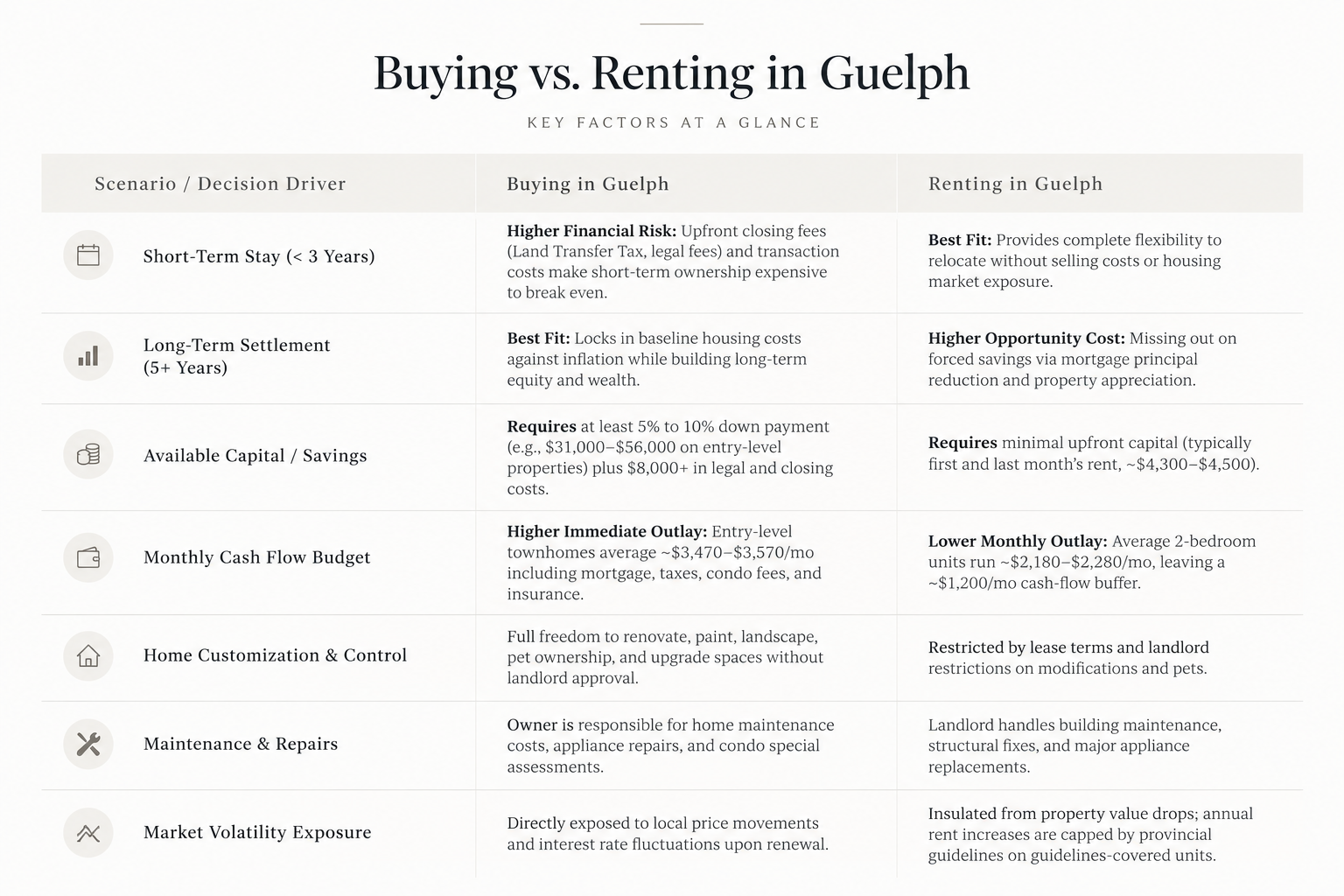
General Cost & Lifestyle Comparison
For standard first-time buyers or current local renters, here is how the choice breaks down across key financial and lifestyle scenarios:
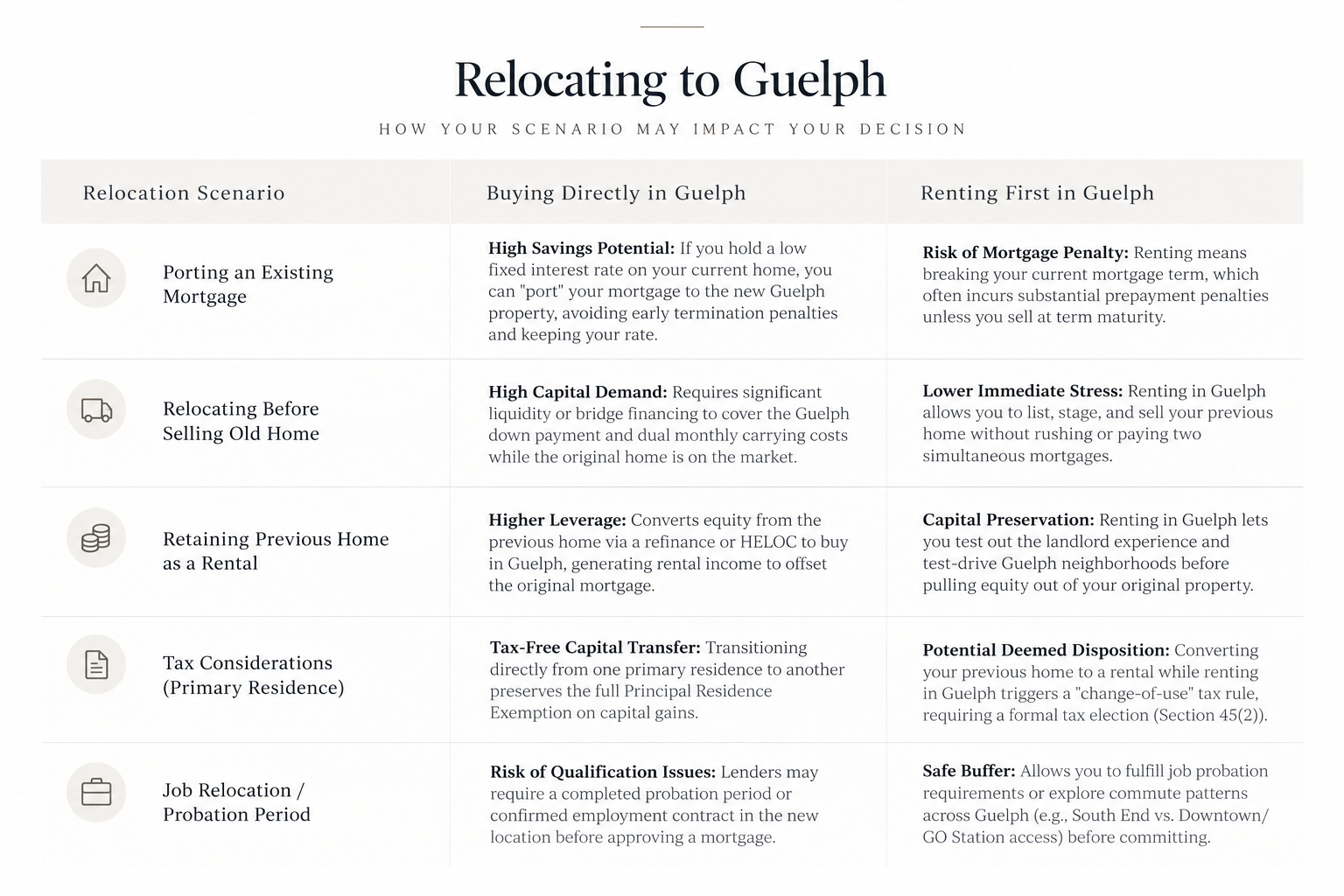
Special Scenarios for Relocating Homeowners
If you already own a home elsewhere and are relocating to Guelph, your decision involves porting mortgages, managing two properties, tax implications, and timing equity transfers:
Summary Takeaway
MLS statistics show Guelph operating in balanced-to-buyer’s market territory, giving prospective buyers time to include standard financing and inspection conditions without facing aggressive bidding wars. Ultimately, renting suits those who need short-term mobility, plan to move within 1 to 3 years, or need time to sell an out-of-town home without pressure. However, if you have accumulated a down payment and plan to stay put for 5 years or longer, securing an entry-level property in today's market provides a reliable foundation for long-term financial growth.
Citations & Sources:
CREA / Local MLS® Market Data: CREA Guelph & District MLS® Housing Market Stats & CREA MLS® Home Price Index Benchmark Prices
Rental Market Research: Rentals.ca National Rent Reports
Land Transfer Tax & Rebates: Government of Ontario Land Transfer Tax Refunds